


 Book a time
 Get in touch
Skin Peptides have quickly become one of skincare’s most talked-about ingredients.
They’re included in everything from moisturisers and eye creams to advanced medical-grade serums.
But here’s the problem.
Many products simply advertise “contains peptides” without explaining which peptides they’ve used, or why they’ve chosen them.
The reality is that not all peptides perform the same function. Some support skin firmness, others help maintain the skin barrier, while others are included because of their role within specific cosmetic formulations.
Understanding the difference can make choosing skincare considerably easier.
Skin Peptides Explained: What Each Type Does and How to Read Your Product Label
If you’ve looked at the ingredient list on a skincare product recently, you’ve probably noticed an increasing number of peptides appearing alongside more familiar ingredients like vitamin C, niacinamide and hyaluronic acid.
They’re often marketed as one of the most advanced ingredients in modern skincare, and for good reason.
Peptides have become an important part of many professional skincare formulations because of the role they can play in supporting healthy-looking skin.
However, one of the biggest misconceptions I see is the assumption that every peptide does the same thing.
In reality, peptides are an incredibly diverse group of ingredients. Some are included to support skin firmness, others help improve hydration or soothe visible redness, while others are selected because of the way they interact within sophisticated skincare formulations.
Understanding these differences can help you move beyond marketing claims and make more informed choices about the products you use—especially if you’re wondering when to start using anti ageing treatments.
What Are Skin Peptides?
Peptides are short chains of amino acids, the building blocks that make up proteins within the body.
In skincare, peptides are incorporated into topical formulations because of the important roles they play in maintaining healthy skin and supporting the skin’s natural structure.
Rather than thinking of peptides as a single ingredient, it’s more helpful to think of them as a large family of ingredients, with each peptide designed for a different purpose.
Some peptides are involved in skin barrier function.
Others are associated with skin firmness.
Some are selected for their calming properties, while others are incorporated into formulations targeting uneven skin tone or visible signs of skin ageing—those concerns may also be supported by Laser Treatments.
This is why simply seeing the word “peptides” on the front of a product tells you very little—if you’re also considering exfoliation, explore Skin Peels. To understand what a product has been designed to do, it’s important to look at which peptides have been included.
Why Do Skincare Labels Use Such Complicated Names?
One of the most common questions I hear is:
“Why can’t they just write ‘peptide’?”
The answer is simple.
Every peptide has its own chemical structure and therefore its own internationally recognised ingredient name (known as an INCI name).
While names like Palmitoyl Tripeptide-1 or Acetyl Hexapeptide-8 might seem intimidating, they simply identify the specific peptide that’s been included in the formulation.
Once you understand what each name represents, reading a skincare label becomes much easier.
Not All Peptides Do the Same Job
This is one of the biggest myths in skincare.
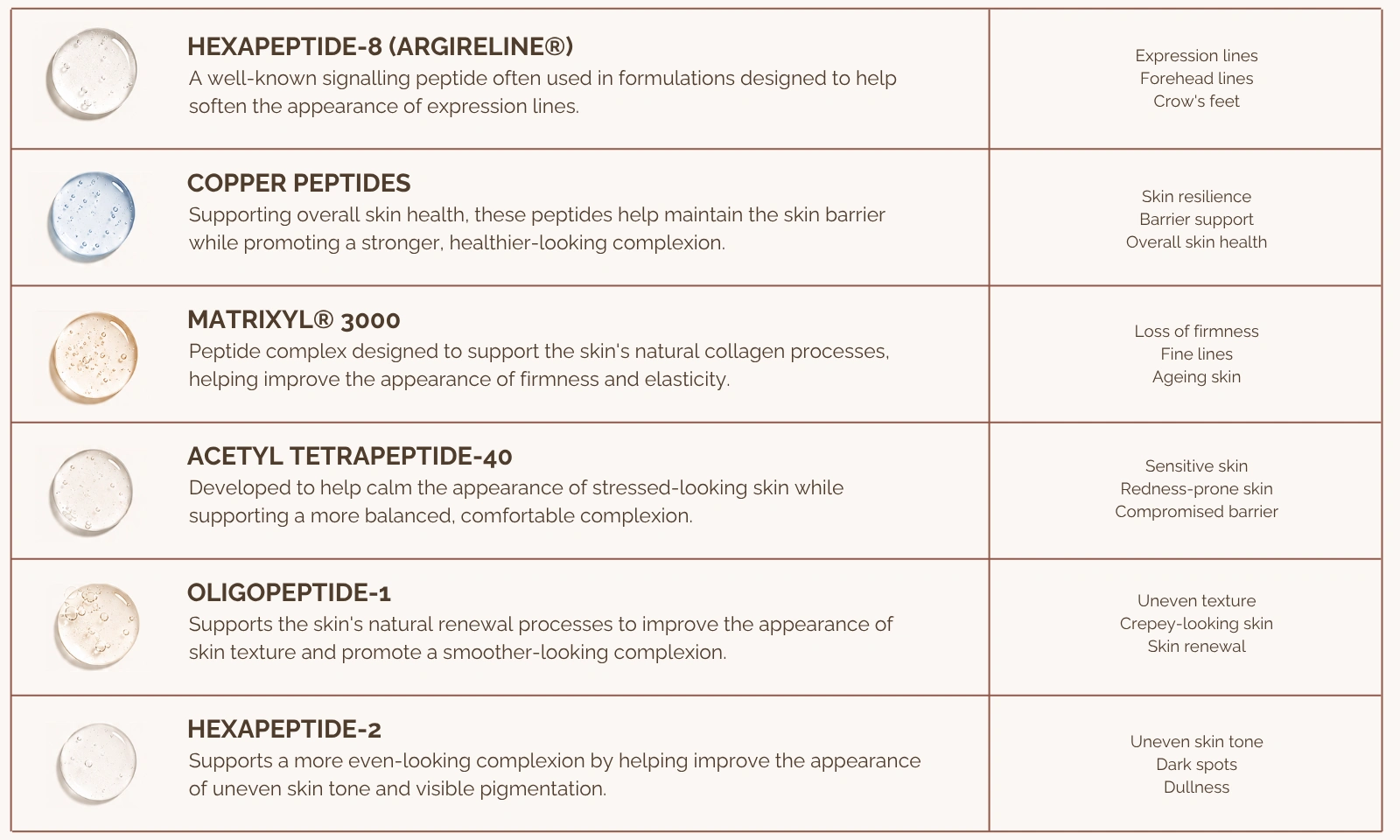
A product containing copper peptides isn’t automatically doing the same job as one containing Matrixyl 3000.
Likewise, a serum designed to target expression lines may contain a completely different peptide blend to one formulated for pigmentation or skin barrier support.
The more you understand these differences, the easier it becomes to choose products based on your skin concerns rather than clever marketing.
The Most Common Skin Peptides Explained
Matrixyl 3000 (Palmitoyl Tripeptide-1 & Palmitoyl Tetrapeptide-7)
If you’ve researched peptides before, you’ve almost certainly come across Matrixyl 3000.
It’s one of the best-known peptide complexes used in skincare and is commonly incorporated into formulations designed to support skin firmness and the appearance of fine lines.
Rather than working like an exfoliating ingredient or antioxidant, Matrixyl 3000 belongs to a family known as signal peptides.
Signal peptides are included in skincare because of the way they interact with the skin and their role within formulations designed to support the appearance of ageing skin.
For this reason, they’re frequently found in products targeting overall skin quality and healthy-looking skin.
Copper Peptides
Copper peptides (GHK-Cu) have become increasingly popular in advanced skincare because of their role in supporting overall skin health. They act as powerful anti-aging actives that signal your skin to repair itself, thereby promoting collagen and elastin production, reducing fine lines, and firming the complexion.
They’re commonly included in skincare formulations that focus on maintaining the skin barrier and supporting skin that appears healthy, resilient and balanced. Because of their versatility, copper peptides are often combined with other ingredients within comprehensive skincare routines rather than used in isolation.
P-TIOX™ Peptide Complex
One of the more recent innovations in medical-grade skincare is the peptide complex found in P-TIOX™.
This formulation combines carefully selected peptides, including hexapeptides and dipeptides, that may work to relax facial tension and modulate muscle contractions, helping to reduce the appearance of dynamic wrinkles, expression lines and visible skin ageing.
Rather than functioning as a replacement for cosmetic procedures, peptide-based skincare is typically considered one part of a broader approach to maintaining skin quality.
Acetyl Hexapeptide-8
Often referred to as one of the most recognised peptides in cosmetic skincare, Acetyl Hexapeptide-8 is commonly included in formulations targeting expression lines and areas of repetitive facial movement.
Its popularity has grown significantly over the past decade, particularly within premium skincare formulations.
Acetyl Heptapeptide-4, Tetrapeptide-2 and Octapeptide-3
Modern peptide formulations rarely rely on a single peptide.
Instead, many advanced serums combine multiple peptides that work alongside one another to support different aspects of skin health.
Acetyl Heptapeptide-4, Tetrapeptide-2 and Octapeptide-3 are examples of peptides that are commonly included in professional skincare formulations designed to support overall skin quality and healthy-looking skin.
While each peptide has its own unique characteristics, they’re often selected because they complement other ingredients within a formulation rather than acting as standalone “hero” ingredients.
This is one of the reasons it’s worth looking beyond the marketing on the front of a bottle and taking the time to understand what’s actually listed in the ingredient panel.
Acetyl Tetrapeptide-40
Healthy skin isn’t just about firmness or smoothness, it’s also about maintaining a balanced, resilient skin barrier.
Acetyl Tetrapeptide-40 is often included in formulations developed for skin that appears reactive or prone to visible redness.
Supporting the skin barrier is an important part of any long-term skincare routine, particularly for people using active ingredients such as retinoids, vitamin C or exfoliating acids. While these ingredients can play an important role in a skincare routine, maintaining overall skin comfort and barrier function is equally important.
Oligopeptide-1
One of the more interesting peptides found in skincare is Oligopeptide-1.
This peptide is commonly included in formulations targeting skin texture and the visible signs of skin ageing, particularly where skin begins to appear thinner or crepey.
Crepey skin often develops gradually as structural proteins within the skin change over time, making the skin appear less smooth and less resilient.
Products containing Oligopeptide-1 are typically formulated as part of a broader skincare routine designed to support healthier-looking skin over time.
Hexapeptide-2
Uneven skin tone is another common concern I discuss with patients.
Whether pigmentation develops following sun exposure, hormonal changes or previous inflammation, many people begin searching for ingredients that can help support a brighter, more even-looking complexion.
Hexapeptide-2 has become an increasingly recognised peptide within skincare formulations targeting uneven skin tone and the appearance of dark spots.
As with all skincare ingredients, it’s important to remember that no single ingredient works in isolation. Daily sun protection and a consistent skincare routine remain fundamental when addressing pigmentation concerns.
How to Read a Skincare Ingredient Label
Once you understand a few key peptide names, reading an ingredient list becomes much less intimidating.
Rather than simply looking for the word “peptide” on the front of the packaging, turn the product over and read the ingredient panel.
Look for the individual peptide names and consider whether they’re appropriate for your skin concerns.
For example, if your primary concern is the appearance of expression lines, you might notice ingredients such as Acetyl Hexapeptide-8 or peptide complexes specifically formulated for this purpose.
If you’re focused on supporting overall skin quality and firmness, products containing Matrixyl 3000 or copper peptides may be included within a broader skincare routine.
Understanding what each ingredient has been formulated to do helps you make more informed decisions, rather than relying solely on marketing claims.
Should You Choose a Product With One Peptide or Several?
Another common misconception is that more peptides automatically mean a better product.
In reality, it’s the overall formulation that matters most.
Professional skincare products are carefully developed so that ingredients work together within a balanced formulation. This means a product containing several complementary peptides isn’t necessarily “stronger” than one containing a single, well-chosen peptide.
It’s also worth remembering that peptides are just one part of an effective skincare routine.
Other ingredients, including antioxidants, sunscreen, vitamin C, retinoids and hydrating ingredients, all have important roles depending on your skin type and concerns.
Rather than focusing on a single ingredient, I encourage patients to think about how each product contributes to an overall evidence-based skincare routine.
How Do You Know Which Peptide Is Right for Your Skin?
The answer depends entirely on your individual skin concerns.
If your goal is to support skin that appears firmer, the peptides included within a product may be quite different to those selected for visible redness or uneven skin tone.
Similarly, someone concerned about early expression lines may benefit from a different formulation to someone whose primary concern is maintaining overall skin health.
This is why personalised skincare is so important.
Instead of asking, “What’s the best peptide?”, a more useful question is, “Which peptide is appropriate for my skin?”
Once you understand that different peptides perform different roles, choosing skincare becomes considerably less confusing.
Frequently Asked Questions
Are peptides good for every skin type?
Generally, peptide-containing skincare is suitable for many skin types and is commonly incorporated into routines for healthy ageing, hydration and overall skin quality. The most appropriate formulation will depend on your individual skin concerns and the other active ingredients you’re using.
Can I use peptides with vitamin C?
Yes, in most cases you can use peptides with vitamin C.
Most modern skincare products are formulated so that peptides can be used alongside ingredients such as vitamin C, hyaluronic acid and niacinamide as part of a well-rounded skincare routine. Many commercially formulated serums are designed to be compatible, making them suitable for use together.
One exception is copper peptides (such as GHK-Cu) when used with pure vitamin C (L-ascorbic acid). Because L-ascorbic acid is formulated at a low pH, it may reduce the stability or performance of copper peptides. If you’re using both, it’s generally recommended to apply them at different times of day, such as vitamin C in the morning and copper peptides in the evening.
If you’re unsure how to combine your skincare products, speak with your clinician or skincare professional for personalised advice.
Can peptides be used with retinol?
Yes. Peptides can generally be used with retinol and are often included in the same skincare routine.
Peptides work differently to retinoids and are compatible with most skincare ingredients. Many people use peptides alongside retinol to support the skin barrier and complement an overall skincare routine.
If you’re new to retinol, introduce it gradually and use products as directed to help minimise irritation. If you have sensitive skin or are unsure which products are suitable for you, seek personalised advice from your clinician or skincare professional.
Are all peptides the same?
No. Not all peptides are the same, and different peptides have different functions in skincare.
Some peptides are designed to support skin hydration, while others are studied for their role in supporting the skin barrier, improving the appearance of firmness, or promoting a smoother-looking complexion. The benefits of a skincare product depend on the specific peptide or peptide blend it contains.
That’s why it’s more important to understand the ingredient list than simply look for the word “peptide” on the front of the packaging.
At what age should I start using peptides?
There isn’t a specific age at which you should start using peptide-containing skincare.
Whether peptides are appropriate depends more on your individual skin concerns, overall skincare routine and long-term skin health goals than on your age. Peptides can be incorporated into a skincare routine at various stages of adulthood, depending on the formulation and your skincare objectives.
If you’re unsure whether a peptide product is suitable for your skin, a skincare professional can recommend a routine tailored to your needs.
Do peptides replace cosmetic treatments?
No. Peptide skincare does not replace professional cosmetic treatments.
Peptide-containing skincare and cosmetic treatments serve different purposes and are often considered complementary components of a personalised treatment plan. While skincare supports your daily routine, in-clinic treatments are selected based on your individual concerns, goals and clinical assessment.
The most appropriate approach will depend on your skin, your objectives and the recommendations of your treating clinician.

Build a Skincare Routine That’s Right for Your Skin
With so many skincare ingredients available, choosing the right products can quickly become overwhelming.
Alongside my team at Ascension Cosmetic Medicine, we take the time to understand your skin, your concerns and your long-term goals before recommending a personalised skincare routine. Whether you’re looking to simplify your current regimen or better understand the ingredients you’re already using, the team can help you make informed, evidence-based decisions that support your skin over time.
Disclaimer
This article is for educational purposes only and does not constitute medical advice. All treatments carry risks and may not be suitable for everyone. Individual results will vary. A consultation with a qualified health practitioner is required to determine appropriate treatment options.
Reviewed by Dr Scott Allison (MED0001664087), Registered Medical Practitioner, specialist registration in General Practice.

 Book a time